
Felinis Cognitus, Hominis Perplexus

Temple Grandin, the autistic animal behaviorist and professor, once said that she knows what animals are thinking and how to work with them because they think in pictures, much like autistic people do. This makes sense if you’re talking about, say, a stallion, which probably spends his time visualizing vast open fields, potential escape routes, and maybe that mare from the neighboring pasture whose powerful haunches give new meaning to the phrase “the horse reared up.”
But neurodiversity applies to animals, too. Not all animals live in picturesque, Instagram-worthy environments. Bats and owls are nocturnal and sense the world through sound. Giant squid live at ocean depths where no light penetrates. Naked mole rats live in pitch-black tunnels where the most visually stimulating thing they ever encounter is the preceding mole rat’s rectum. I can’t imagine a naked mole rat sitting around thinking in pictures. What would it picture? Darkness? Slightly different shades of darkness? A vague impression of their tunnel mate’s anus?

Plenty of animals that do move around in the light still experience the world in non-visual ways. Dogs track by smell. Sharks and rays detect prey through electric impulses. Many birds navigate using Earth’s magnetic field. And cats? Cats operate by royal decree and selective sensory input. They won’t come when you call them, but they can hear a can of tuna opening from two rooms away. During a thunderstorm. While asleep. Probably dreaming of ignoring you.
And not every member of a species interacts with the world the same way. My niece’s greyhound, Napoleon, is basically a cat disguised as a dog. He sleeps 20 hours a day, only arising for what they call a “walk”—which is really just a burst of feral energy like a cat with the zoomies. Then he collapses again, as if standing upright for more than 15 minutes violates the terms of his contract. He’s not big on affection either. His attitude is more, “If you want to pet me, that’s your business—but I’m not moving off this cushion.”
Even among the so-called hive minds, individuality finds a way. Ants, for instance. Genetically identical. Same colony. Same job. Same tiny black uniform.
And yet, behavioral diversity abounds.
When you see a column of ants on the move, observe carefully. Some are up front blazing the trail (that’s Gavin—classic overachiever). Some lag behind to smell everything twice (hi, Denise). And some, like Steve, are back at the nest eating mold and tidying up, because the lighting’s better and they didn’t sign up for group cardio.
(I relate to Steve. He’s one of us.)

Even among neurodiverse humans, there’s no standard model.
I may be on the autism spectrum, but I don’t think in pictures. I think in words. If you say “blue sky,” I don’t see a blue sky. I see the words “blue sky,” floating there like a chapter title with no text beneath. And when I do see an actual blue sky, my brain doesn’t fuse with the image like a stoner locking eyes with a lava lamp. I just think, “Ah. Blue sky.”
So no, I don’t believe being an animal, human or otherwise, means you automatically think in cinematic IMAX. And yet, Temple Grandin was onto something. Like other autistic people, I understand many non-human animals better than I get most people.
Take cats, for instance. I get their emotional vocabulary—the flick of a tail, the casual ear swivel, the precision with which they push my favorite mug off the counter. I know that when a cat arches its back, it’s feeling threatened, and when it blinks slowly, it’s showing affection. I can read an entire feline personality from the angle of the whiskers and the geometry of their judgmental stare. And I sympathize that they see the world from the perspective of our ankles, so they naturally scale Mount Refrigerator—ancestral throne of feline superiority—to restore balance to the universe and remind us of who’s in charge. (It’s not the one buying the kibble).
Meanwhile, my neurotypical wife is oblivious to cat consciousness. I try to help her with our cat, Mittens, gently suggesting that maybe Mittens doesn’t like being petted like that. My wife looks at me and asks, “How do you know?” And I just stand there, blinking—and not as a sign of affection—because the cat is clearly broadcasting “I DON’T LIKE TO BE PETTED LIKE THAT” in 15 languages and 40 frequencies of silent rage.
Professor Grandin has actually written about the animals that rely less on sight and more on sound, smell, and touch.
And vibes. (Not her word. But it fits.)

And when Mittens gets up, stiffly offended, and walks away with the body language of someone who just got groped on the subway, my wife just shrugs and says, “See? She didn’t run away.”
I’ve tried educating my zoologically illiterate wife, but it’s a risky proposition. I’ll say something like, “See how Mittens flicked her tail, flattened her ears, and vanished behind the fridge? That’s a cat about to file a grievance with Feline Resources.” But I may as well be speaking Korean through an aquarium wall—the exact thought written across Mittens’ muzzle as she indignantly pads away.
My theory—backed by zero research and even less data—is that autistic people are simply more in touch with our atavistic animal wiring. That’s why we avoid direct eye contact. In the primate world, it’s the universal signal for aggression. This is true of our closest relatives—the chimpanzees and the gorillas. So when I avoid locking eyes with someone, I’m not being rude; I’m just trying to avoid a fight to the death.
Ironically, the same lack of social skills that inhibits us from gazing lovingly into each other’s eyes are the very ones that keep our animal instincts razor sharp. Feral children, for instance, can’t empathize or master small talk, but they can apparently wrestle wolves for table scraps, proving that nature still rewards instinct over etiquette. So while others like to think of socialization as “progress,” I suspect it’s really natural selection taking a coffee break.
Maybe the best way to understand this is to rewind 30,000 or 40,000 years—to a time before HR departments, self-help podcasts, and scented candles.
Enter Glarn, the caveman. He wakes to a perfect Paleolithic morning. The robins and wrens are greeting the day, so he knows he hasn’t overslept. He inhales deeply and detects no rain, no predators, and no visiting relatives. The still air tells him his scent won’t carry far to any animal he doesn’t want to notice him. It’s going to be a good day to survive.
As the light grows, Glarn glances back at his wife, Oona, still snoring softly under their cave bear blanket. He steps outside to begin his daily hunter-gatherer routine. His senses switch on—ears track the crack of a twig, nose catches a faint musk, eyes follow the twitch of a leaf that shouldn’t have twitched. He crouches low, heartbeat syncing with the stillness around him, until a plump rodent betrays itself with a rustle. One smooth throw of his stone, one brief squeak, and breakfast is solved—cleanly, efficiently, and without a single peer review.
Later, when his friends join him to track larger game, the rhythm stays the same. Nobody bothers with strategy sessions or motivational grunts, and the project plan is communicated entirely through eyebrow work. They move in silence, a pack of hyper-focused introverts with spears. When an antelope finally breaks cover, they give chase across the plain—quiet, efficient, and slightly irritated at its lack of cooperation. A few well-aimed throws later, the creature goes down. There’s no applause, no selfies, and nobody drags a task card across a kanban board.
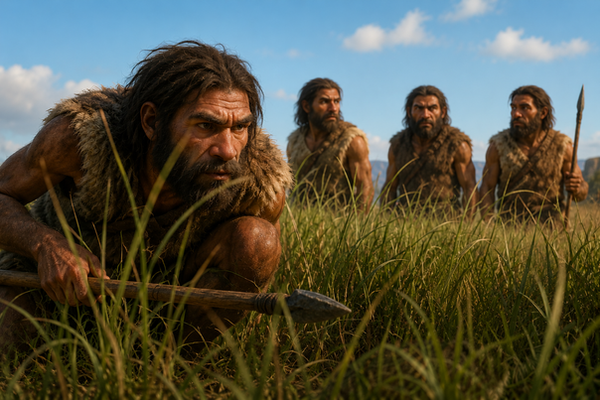
That evening, Glarn sits by the fire with his small clan, savoring the sweet, smoky meat of the hunt. Sparks coil upward into the dark, and the smell of charred grass and fat hangs in the still air. Each person sits lost in thought—or possibly inventorying their fingers after a narrow escape. Nobody asks Glarn what he’s thinking. Nobody fills the quiet with “just checking in.”
But peace is fragile, even in paradise. As the stew pot makes its way around, Brog—the clan’s self-appointed culinary influencer—does what he always does: cherry-picks the antelope nostrils before passing the bowl along. Glarn watches, jaw tightening. Then, in a burst of righteous frustration, he stands and flaps his arms, emitting a sound somewhere between a growl and a TED Talk on fairness. Brog ignores him, but Oona rises, fixes Brog with a look that could skin a mammoth, and hands Glarn a perfectly roasted testicle. The clan returns to their silence, and everyone has plenty of time to process their emotions before the next Ice Age.
While anthropologists might call them early Homo sapiens, I call them my people: physically sensitive, economical with words, and prone to flapping in excitement.
Fast-forward several millennia, and our descendants have traded spears for smartphones, mammoth hunts for inbox management, and quiet focus for notification fatigue.
Take Glenda, senior software engineer for SynerTask, who wakes to six competing alarms. Alexa tells her to wake up while her phone pings to remind her to stay hydrated. Her watch vibrates to tell her that her phone pinged. Her laptop joins in with a cheerful “bloop” from a forgotten calendar event titled “Be productive!!!” And somewhere in the distance, a smart TV is trying to pair with her Wi-Fi to let her know that she slept 5 hours and 12 minutes, ranking her in the 43rd percentile of people who are also running on Red Bull and affirmations.

Her home hub app, ever vigilant, has got her toaster charring high-protein bread at precisely 7:02, while the coffee maker gurgles to life. A timed puff from her Pura Home Scent Diffuser releases a fragrance called Forest Synergy, which smells nothing like a forest and exactly like Synergy, if it had been left out in the rain and mildewed.
While Glarn’s breakfast was an animal he caught and roasted, Glenda’s is a choice between four types of granola and three brands of oat milk, none of which taste like oats, milk, or choice. She spoons her granola with one hand while the other scrolls through headlines about the end of civilization, occasionally switching over to email or Slack as they issue fresh commands for her attention.
When she arrives at SynerTask, Glenda doesn’t hunt, gather, or otherwise contribute to the continuation of the species. She generates bytes—tiny electrical on/off blips that can’t be seen or felt, yet somehow must be delivered by the end of Q1. Those bytes eventually coalesce into an algorithm that supports a feature that’s part of an app that allegedly provides value, though nobody can explain how it advances SynerTask’s mission statement: Empowering people to leverage optimization through task-aligned governance.
Glenda’s routine looks like success because we like to measure functionality by how well someone fits into the modern environment. But she would have been useless in Glarn’s time. Conversely, those autistic adults who are mostly non-verbal and labeled “dependent” or “non-functional” might have been revered in Glarn’s tribe. They would have been the ones who could sense danger in the air, a change in weather, or the faint tension in a predator’s silence. In a quiet, instinct-driven world, those sensitivities weren’t disabilities; they were superpowers. Then language evolved, and abstraction replaced intuition. The more we learned to talk about things, the less we seemed to truly know them.
Humans made the world louder, then decided sensitivity was the problem.
Our animal instincts never fully disappeared; they just got buried under etiquette, productivity apps, and the illusion of control. Cats, wisely, refused to participate. They remained self-governing, mysterious, and only loosely affiliated with the human project. Dogs, on the other hand, signed a long-term domestication contract. Over the millennia, neurotypicals bred them in their own image—social, eager to please, and slightly codependent. Which means that although I speak cat fluently, I can only understand dogs the same way I understand humans. I know what they’re feeling; I just have no idea why. They’re either indecently happy or actively gnawing on my leg, and I can’t tell what I did to deserve either.
A dog can be wagging its tail, panting like an accordion in heat, and making little squeaky noises. I know it’s excited, but I’m still wondering: Are you declaring your undying loyalty or about to take a poop on the carpet?
I genuinely don’t know.
Once, a friend brought over a golden retriever who seemed thrilled to meet me. His tail was twirling like a ceiling fan on Red Bull, and he made a high-pitched squeal that could’ve meant he loved me, he was having a stroke, or that his microchip was shorting out. I tentatively scratched his ear and he immediately flopped over—four paws in the air, tongue lolling, pinning me with a stare like I’d been sent to fulfill a prophecy.
My friend smiled and said, “He likes you!” But I couldn’t shake the feeling that I was being emotionally manipulated by a quadrupedal blonde himbo—one who had chosen to express affection by presenting his most intimate geometry to someone who is biologically averse to unsolicited intimacy.
It would be so much easier if animals just agreed on a universal set of signals—maybe during an interspecies summit. But alas, one creature’s love letter is another’s arrest warrant.
Take the slow blink.
In cats, it’s tender affection. A furry little “I love you.”
In dogs, it’s more like “I have no idea what you want, but I will support your journey.”
And in a silverback gorilla, a slow blink means “I’m feeling romantic.” Which sounds sweet—until you realize they go from eye contact to full-blown jungle jiggery in under a second.
Gorillas don’t light candles.
They don’t ask permission.
They don’t wait for the Spotify playlist to load.
And they definitely don’t have safe words.

What they do have are testosterone levels visible from orbit. And while “great apes” refers to size, it’s not referring to their impulse control, emotional depth, or their comically tiny chastity gland.
No—you lock eyes with a gorilla at the wrong moment, and you’re not flirting. You’re sending an invitation to a 400-pound love tank with no brakes, no boundaries, and a mating strategy that starts at “GO!”
So it helps to be attuned to animals. I’ve got a solid handle on cats, horses, and social insects. Dogs and I have a diplomatic arrangement. Bears? I respect them from a distance—and I feel like they respect me from a disconcertingly smaller distance.
While I can’t profess native-level fluency in Animal, even the species I don’t totally understand still make more sense to me than most people. And I don’t think that says anything about the neurodiverse—it says everything about the other humans.
For one thing, animals don’t lie about how they feel. If a cat is done with me, she leaves. If a horse is upset, it will rearrange my skeleton. Humans, on the other hand, will smile and say, “I’m fine,” while blinking SOS in passive-aggressive Morse code.
Animal social rules are also refreshingly straightforward. No small talk. No wedding politics. No “we should totally get lunch sometime!” when they absolutely never will. Just “Here’s my tail position. Adjust your behavior accordingly.”
They’re also far more sensory-friendly. Warm. Furry. Predictable. And they’ve never caused a meltdown by showing up wearing cologne, dragging me into a fluorescent nightmare, or insisting we “do a quick icebreaker.” Mittens has never worn Crocs or tried to high-five me.
While animals might deceive you, at least they know they’re doing it. A fox understands it’s being sneaky. Humans will gaslight you, forget they did it, and then rebrand the whole experience as “gentle guidance.”
And finally, animals come with fewer settings. Sure, I don’t always know why a dog feels what it feels—but the menu is short: ecstatic enthusiasm, mild jealousy, existential panic, or I will now maul your liver and wash it down with the tears of your mail carrier.
In short, animals are consistent, literal, and low on drama.
So the issue, when you really boil it down, is with one particular species: Homo sapiens neurotypica—a puzzling variety known for its social rituals, inconsistent signaling, and irrational fondness for surprise parties.
My solution? I picture them as non-human animals. It won’t make their behavior less weird, but it might make it more understandable.
My boss, for example—the one who never says thank you and stares at me like I’m a disappointing houseplant. That’s a cat. Aloof. Territorial. Judgmental. I wouldn’t expect a cat to appreciate your PowerPoint—I’d just be grateful it didn’t knock over my coffee and walk across the keyboard.
Or Jeff, the flaky guitarist in my band who forgets the setlist, eats all my snacks, and needs constant praise not to emotionally collapse. He’s a golden retriever. He’s not disorganized, he’s just disturbingly invested in my approval. Also, he may pee when excited, so I try not to scratch behind his ears.
My coworker who won’t stop talking about her juice cleanse. That’s a parrot. Loud. Repetitive. Possibly beautiful but mostly interested in hearing herself squawk.
Or take Brandon from Accounting, who shows up at my desk every Monday, uninvited, holding a smoothie made from lawn clippings and broken promises. “Rough weekend?” he asks. “You should really try cold plunges—life changing.”
I used to wonder: Why does Brandon feel entitled to access my emotional dashboard? Why does he say “Let’s circle back” like it’s a sacred vow? Why does he high-five people who clearly flinch?
He doesn’t ask if he’s welcome—he assumes he is, loudly and repeatedly, because he means well. And when I don’t respond the way he expects, he tilts his head like I’m the one who missed a social cue.
Then it hits me: Brandon is a Labradoodle. But not the sweet, empathetic kind. He’s the kind that jumps onto my lap covered in pond water while I’m wearing white pants.
So I stopped trying to reason with Brandon. I stopped waiting for him to notice my body language, tone, or dead eyes. Instead, I use the only language he understands: “Good boy, Brandon. You circled back. Now go chase that invoice and bring it to Cheryl. That’s it. Good boy.”

Once I started seeing humans as animals—complex, peculiar, emotionally fragile animals with Wi-Fi and cappuccinos—it became easier to forgive their behavior. Or at least lower my expectations to something more biologically appropriate—like appreciating them for not humping my boundaries.
At the end of the day, we’re all just creatures trying to navigate our little corner of the savanna—some with spreadsheets, some with chew toys, and some (like Steve the ant) who opt out entirely to eat mold in peace. He’s not lazy—he just never bought into the normling illusion that motion equals progress.