Genius, Eccentricity, and Collateral Damage

Life on the spectrum can feel like we’ve had superpowers dropped at our doorstep that we never actually ordered. And there’s no manual, no warranty, and no diagram showing how to apply them in a world built for someone else.
We see patterns no one else notices, solve problems sideways, and dive so deep into a subject that we practically fuse with it. The result? We often fly through life’s intellectual challenges—hopelessly tangled in a socially offensive cape fastened with a kryptonite clasp.
Our solutions may involve a new type of math, Ancient Greek, or a diagram scrawled on a napkin in mustard, ketchup, and something we sincerely hope was soy sauce. It’s powerful stuff, but an instruction manual would be helpful—especially for the parts involving other humans.
Every so often, traits like that produce someone who changes the world, often before they‘ve dropped out of college. They somehow survive a society that mistakes their eccentricity for error, and once they unleash their genius, that eccentricity gets revised as charming backstory.
Albert Einstein, for instance, discovered relativity and reshaped physics, but couldn’t reliably locate his keys. Small talk bored him, etiquette confused him, and he once forgot to pick up an award because he got lost in a math problem. He could unlock the mysteries of the universe—but not his front door.
Nikola Tesla gave us alternating current and half the modern world’s electrical conveniences. But for some reason he refused to touch anything not divisible by three. His idea of romance was even quirkier. In lieu of humans, he fell in love with a white pigeon. And in a gesture that would have impressed medieval poets, he named her “The White Pigeon,” surpassing timeless names like Venus, Aphrodite, and Cleopatra. His mind could wire a city, but human connection was one circuit he never quite managed to complete.
Then there’s Leonardo da Vinci, who imagined helicopters, dissected corpses, painted the Mona Lisa, and invented innumerable contraptions that he never bothered to build. He hyperfocused on everything—well, at least until something shinier came along. He abandoned projects the way other people lose socks, but spent 16 years tweaking the Mona Lisa because he couldn’t stop second-guessing her smile.
Of course, no celebration of neurodivergent genius would be complete without honoring two illustrious members of the Autistic Hall of Fame: Emily Dickinson and Henry Cavendish—proof that you don’t have to leave the house—or even make eye contact—to leave a permanent mark on human history.
Emily Dickinson wrote nearly 1,800 poems while speaking to guests through closed doors and communicating with her household by note. If DoorDash had existed in the 1800s, she might still be writing today.
Henry Cavendish discovered hydrogen, mapped Earth’s density, and accidentally invented modern chemistry, all while avoiding people. He was so reclusive that even his servants had to communicate with him by letter. His crowning achievement? Building private staircases so he wouldn’t have to bump into guests.

Introverts everywhere immediately promoted him to patron saint.
Cavendish may have cracked the secrets of chemistry, but like many neurodivergent minds, he still had to navigate a world that mistook eccentricity for error. For those of us whose ideas aren’t reshaping physics or electrifying cities, our eccentricity mostly guarantees that we’ll be misunderstood, underestimated, and—when we’re lucky—excluded from many social events. That’s when we’re tempted to adapt by masking, which is a fun and casual term for “exhausting yourself pretending to be someone you’re not in order to survive a world that finds you mildly unsettling.” Many of us hide our differences as if we’re trying to sneak endangered wildlife past customs—hoping no one notices that our emotional baggage is snarling and leaking urine.
But let’s not pretend masking is our own private club. Normlings do it too; they just call it “being normal.” They think nothing of chuckling at a joke that died years ago, or nodding wisely during a conversation about quantum physics. The difference is that they do it effortlessly.
They were born with the instruction manual.
Meanwhile, we’re trying to reverse-engineer it and missing a few crucial steps—like eye contact.
Or speech.
Or wearing pants.
I could go on.

Some of us mask by overcompensating. Think Bruce Jenner gunning for gold at the “I’m Just Your Ordinary Olympian” decathlon while his true self is pacing in the back of his mind like, “Sure, I can challenge gender norms and dare the world to blink—but let me nail the qualifying heats first. I’ll deal with my uniform later.”
Of course, not all of us chased accomplishment or respectability. Some of us ran screaming in the other direction. While others were busy polishing their polite personas or overachieving at their specialty, I overcompensated by becoming proudly, unapologetically unacceptable.
I was a gifted child, which sounds great until you realize it was in the 1960s —an era when there were few special programs, no understanding of different wiring, and the only accommodation was to skip grades. That’s right: adults rewarded me for doing well by pushing me into increasingly more bewildering social encounters with students twice my maturity. And although my classmates wore roughly the same bewildered expression, theirs was from long division, mine from trying to survive recess without making eye contact.
I was bored by a world that offered little to engage me.
Scolded by a world that disapproved.
Terrified by a world where the other boys were aggressive thugs.
Alarmed by a world where puberty and sex loomed ahead like dragons drawn into the margins of a medieval map.
I could go on.
So where does a cognitively adventurous but neurologically inconvenient child turn to for recreation? Drugs and crime—naturally.
By middle school, I was popping uppers and downers with the casual dedication of a washed-up lounge singer on a discount cruise ship. This drew me into the orbit of young criminals—boys who frightened and fascinated me in equal measure. They were everything I wasn’t: loud, reckless, violent, and entirely sure of themselves. And their society had much lower standards for belonging, which meant I was finally granted admission. I kept my place in their world by making them laugh; they kept theirs in mine by dragging me miles outside my comfort zone.
Jokes for adrenaline—it was a terrible trade deal.
My friends were criminal, yes—but still unmistakably neurotypical. They broke into houses to steal stuff: cash, electronics, and maybe some liquor if they wanted their alibi to include vomiting in a hedge.
Not me.
I’d break into a house, then leave behind a single unopened condom and a slightly dog-eared Playboy in the sock drawer. Not right in front, though. I’d place it just far enough back that it would take months to discover, preferably during an argument about trust.
Or I’d rearrange the entire medicine cabinet into a perfect mirror image of itself, so everything looked normal until they reached for the aspirin and found toothpaste.
Or I’d replace the contents of a shampoo bottle with Gatorade.
I could go on.
I wasn’t a thief—I was more like a domestic prankster who toys with his normling prey without ever getting blood on himself.
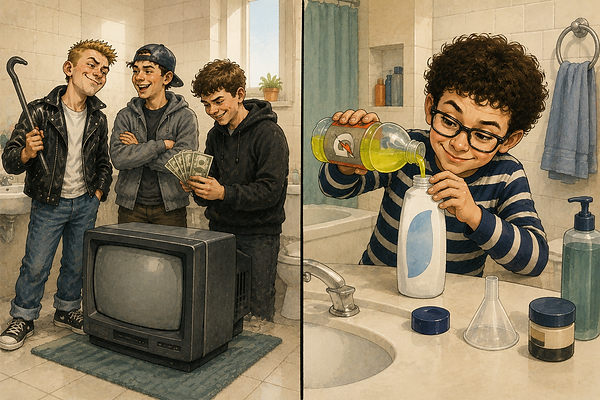
Einstein discovered relativity. Tesla figured out alternating current. Cavendish invented modern chemistry.
I replaced shampoo with Gatorade.
Some self-awareness would have been nice. Some minuscule flicker of insight into why I was acting out, or what I was trying to prove. But instead, I doubled down and spent junior high outshining my friends in delinquency until halfway through ninth grade, when I earned my first felony conviction and got expelled from school.
I remember the drive home from the police station. My mother cried the kind of tears that make you miss your turn twice and forget where you’re going. But that was the last time she cried. She had tried to be the disciplinarian, the one holding me back from total freefall. But after that day, she went quiet. No more yelling, no more pleading. She just let go—of me, of control, and of the exhausting struggle to keep me on the right path. In giving me my freedom, she found hers.
I’d won, if you want to call it that—a conclusive, defiant victory over authority, structure, and parental oversight. But even then, somewhere in the back of my mind, I knew I hadn’t just broken the rules—I’d broken something between us. Something warm and fragile that wouldn’t grow back.
And that’s when my guardian brain-gel stepped in, rolled its eyes, and decided—without consulting the rest of me—that I couldn’t afford to fret over human connection. I didn’t feel any better, I just stopped feeling.
Ironically, my criminal career also came to a screeching halt. With nothing left to feel, there was nothing left to push against.
At high school, my body showed up, but mentally, I was sleepwalking through classes that required less effort than peeling a banana. I found my way into music as a bass player in rock bands—not to express myself, but to disappear into the noise, the chemicals, and a persona that hid the anxious mess underneath, from myself as much as anyone else. But on some level, I knew the masking wasn’t fooling anyone; it only disguised the reasons.
College was my golden era—on paper. I won the Outstanding Student Award in junior college, the composition award in undergrad, and a music theory scholarship in grad school. If GPA were currency, I could’ve retired at 25. I think I still have those awards in a box somewhere, nestled between outdated tax returns and a tangle of electronics from the 1980s. What I don’t have, though, is a single friend from that time. Apparently, people found me impressive—but not exactly keep-in-touchable.
Awareness seemed to be actively dodging me.
As an adult, I mastered emotional shutdown the way some people master chess: with quiet precision, no eye contact, and a strong preference for games that conclude swiftly. I had friends. I had girlfriends. I just didn’t have any particular attachment to them. If a relationship required emotional depth, I quietly headed for the door. No drama. No shouting. Just absence—my most reliable form of participation.
Awareness remained nowhere in sight.
At work, things were much like you’d expect. I was the guy who spotted a chasm in the road five miles ahead. And instead of patiently nudging people while they argued about which font to use for the “Chasm Ahead” sign, I got frustrated and built the bridge myself.

Apparently teamwork was expected. But my neurodivergent brain couldn’t fathom how others didn’t see the solution. To me, it was obvious—impossible to miss. I thought the others were being lazy, difficult, or intentionally hostile. It didn’t occur to me that I needed to walk people through it step by step.
It wasn’t until my fifties that I befriended a remarkable woman named Fae Rubenstein who worked with autistic children. Fae had a knack for decoding social puzzles that stumped others. While most of my friends responded to my offbeat remarks with rolled eyes or gentle coaching, she engaged with them—treating each one as a clue to help her become a better friend. I always appreciated my friends’ coaching, but Fae taught me what it felt like to be accepted.
One evening, she took me aside after I delivered an insightful dinner-table analysis of the evolutionary advantages of flatulence.
She didn’t lecture. She didn’t scold.
She simply handed me a book about Henry Cavendish.
I read it. I reread it. And then, realizing how I had squandered my life pretending to be someone I wasn’t, I spent the whole night crying into my pillow like a howler monkey auditioning for a Yoko Ono tribute band.

If I had understood earlier, maybe I would have built a life with greater accomplishments, fewer broken friendships, and way more secret staircases. But Awareness, ever the last-minute guest, seems to be meandering in during the closing credits—probably just ahead of Dementia and Infirmity.
And so, as I approach my seventies, I find myself finally being true to my gloriously misaligned, neurodivergent nature—tripping over my cape yet again to share my crooked, smudged map held together by dark, dry humor for the Irregulati who keep getting lost in the terrain, and the normlings who can’t understand why.